
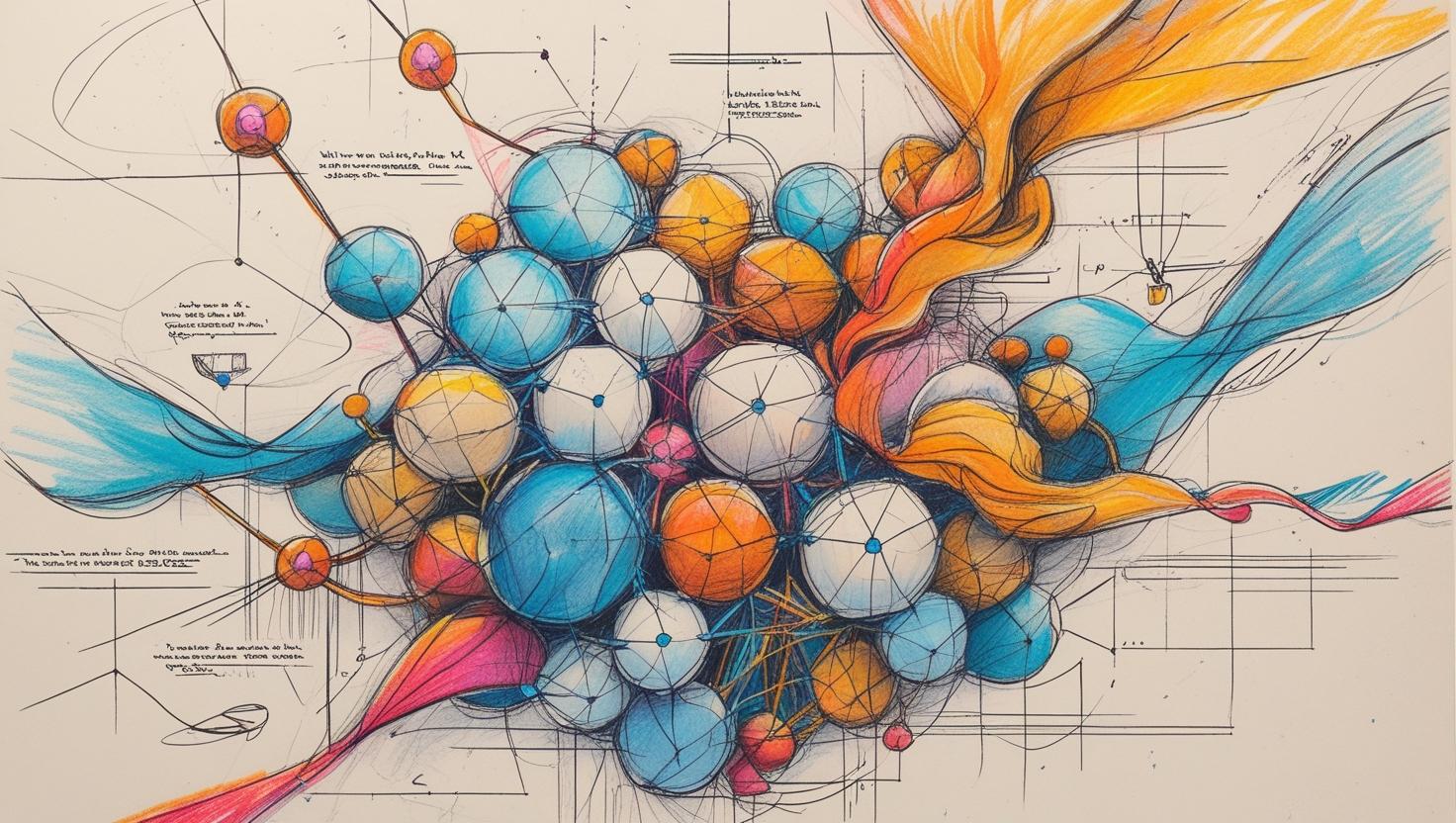
Computational Principles of Relational Learning and Structural Intelligence
Abstract
Intelligence is inherently structural. It does not emerge from isolated inputs, but from the patterns of connection between them: networks of entities, relationships, hierarchies, and transformations. In the human brain, thought unfolds through such structure: semantic associations, causal chains, conceptual graphs, and context-aware inference. This topology is not incidental, it is the shape of thought itself.
Graph Neural Networks (GNNs) offer a computational framework that approximates this paradigm. Unlike traditional models that operate on fixed-size vectors or sequences, GNNs learn by propagating information through graphs, allowing them to model relational, non-Euclidean domains with contextual sensitivity. Through mechanisms such as message passing, attention, and structural aggregation, GNNs encode the principles of relational learning, distributed reasoning, and structure-aware generalization.
This article explores GNNs not merely as machine learning tools, but as architectural hypotheses about cognition and structure. We examine how their core principles mirror aspects of human intelligence (like recursive abstraction, relational memory, and symbolic composition) and how they apply across domains rich in structure: software systems, molecular chemistry, knowledge graphs, and intelligent interfaces. Ultimately, we argue that GNNs signal a broader shift in AI: toward models that do not just process data, but learn over the geometry of cognition, the shape of thought itself.
Index Terms: Graph Neural Networks, Relational Learning, Structural Intelligence, Message Passing, Contextual Representation, Topological Deep Learning, Graph Reasoning, Cognitive Architectures, Non-Euclidean Learning, Symbolic Abstraction, Geometry of Thought.
Introduction: Why Structure Is the Soul of Intelligence
Contemporary machine learning has flourished in domains defined by regularity: images as pixel grids, audio as temporal sequences, language as token streams. These modalities, though rich in variation, conform to Euclidean or sequential structures that permit fixed-size vectorization and locality-aware computation. But beyond perception, intelligence thrives in domains that are irregular, relational, and non-Euclidean.

Language, reasoning, memory, software, and scientific theory are not linear sequences of facts, they are structures of relations. Words derive meaning from syntax and context. Ideas form webs, not chains. Software components interact through dependency graphs, control flow, and semantic types. Molecules bond through atomic graphs; knowledge grows through linked entities. In all these domains, structure is not a byproduct, it is the substrate of meaning.

Human cognition reflects this intrinsically. The brain does not process isolated symbols; it retrieves, transforms, and composes information through structured neural pathways, recursive concepts, and associative dynamics. Cognitive processes, from analogy to abstraction, emerge from networks of relationships, not mere input sequences. Thought, in its very architecture, resembles a graph.

Yet traditional machine learning (ML) isn’t built to understand structure. It flattens everything into vectors, where input order matters and the shape of the data must stay fixed. This works well for images and sounds, but it breaks down when the task involves relational complexity (like understanding programs, molecules, or social networks). In these settings, meaning depends not only on the parts, but on how the parts are connected. We need models that learn from the structure itself, from the geometry of relationships.
Graph Neural Networks (GNNs) emerge as a response to this need. Rather than assuming fixed order or shape, GNNs propagate information across arbitrary topologies, enabling learning over graphs, from software systems to molecules, from user interactions to symbolic structures. More than architectures, GNNs represent a computational hypothesis: that structure is learnable, and that intelligence emerges from its geometry.
This article explores GNNs as a bridge between statistical learning and structural reasoning. We investigate the computational principles behind message passing, structural abstraction, and relational generalization. We analyze how GNNs operate across domains rich in topology, including software engineering, knowledge systems, and cognitive modeling, and argue that they represent an early blueprint for structural intelligence.
Foundations of Relational Representation and Learning
At the heart of intelligence lies the ability to relate: to bind entities together through roles, interactions, dependencies, and context. Whether in the structure of a sentence, the semantics of a software system, or the functional anatomy of a brain, meaning emerges not in isolation, but through relationships. To learn in such settings is to learn relationally.
Graphs: A Universal Substrate for Structure
A graph is more than a data structure: it is a universal language for connectivity.
Formally, a graph G=(V,E) consists of a set of nodes (or vertices) V and edges E that link pairs of nodes. Each node may carry attributes; each edge may encode direction, weight, or type.

Unlike sequences or grids, graphs offer a flexible inductive bias:
- They allow variable-size, non-Euclidean, and permutation-invariant representations.
- They encode local neighborhoods and global topology simultaneously.
- They model heterogeneous entities and typed relations with ease.
In this sense, graphs generalize sets (unstructured collections), sequences (ordered relationships), trees (hierarchies), and even matrices (pairwise associations). They are not limited to spatial proximity or temporal order, they capture semantic, logical, and functional proximity.
What Does It Mean to Learn on a Graph?
Learning on graphs means learning a function over structured input:
- Node-level tasks (e.g., predict properties of a user or a variable),
- Edge-level tasks (e.g., infer links between concepts),
- Graph-level tasks (e.g., classify entire molecular structures or software systems).
But unlike classical ML, where each input is independent and identically distributed, graph learning requires the model to reason over structure:
- A node’s representation depends on its neighbors,
- An edge’s role depends on the context of the nodes it connects,
- A graph’s meaning arises from patterns of interaction, not isolated features.
This introduces the need for relational inductive biases, model architectures that can:
- Respect permutation invariance,
- Propagate information along edges,
- Integrate multi-hop dependencies,
- Generalize across topologically different but semantically similar graphs.
Software as a Native Domain for Graph Reasoning
Graphs are not just theoretical, they are native to software. Unlike pixel arrays or token streams, programs are inherently structured systems composed of multiple, interconnected representations:
- Abstract Syntax Trees (ASTs) encode syntactic hierarchy and scope.
- Control Flow Graphs (CFGs) model execution order and branching.
- Call Graphs represent invocation dependencies between functions.
- Type Graphs capture semantic relationships between objects, classes, and interfaces.
- Dependency Graphs reflect modular architecture and package interconnectivity.
Each offers a semantic lens onto the system. Crucially, learning over these graphs enables capabilities such as bug detection, clone identification, vulnerability analysis, and automated refactoring, all of which require structural awareness.
Similar relational representations arise across domains:
- Recommendation systems: user–item bipartite graphs.
- Biomedicine: protein–protein interaction networks.
- Knowledge bases: entity–relation triples.
- Neuroscience: functional brain connectomes derived from fMRI.
Each domain constitutes its own relational universe. Each requires models that compute over structure, not just over attributes.
Structure is not an annotation: it is the substrate of meaning. In language, syntax determines interpretation. In software, the flow of control defines behavior. In cognition, thought unfolds not as a stream of isolated facts, but as a dynamic web of associations.
If intelligence operates over structured representations, then learning itself must be capable of internalizing structure as a primary signal, not a secondary feature.
In this light, graphs are not an afterthought. They are a computational hypothesis about how meaning is organized, propagated, and transformed. They offer a form that aligns more closely with how knowledge is stored, how reasoning unfolds, and how generalization occurs, not through linear sequences, but through relational geometries.
To treat graphs as first-class inputs is not just a technical decision, it is a philosophical commitment to modeling intelligence as it is: structured, contextual, and interconnected.
Anatomy of a Graph Neural Network
Graph Neural Networks (GNNs) are not a single model, but a computational paradigm, a family of architectures designed to learn from graphs: structures where meaning arises from relation, not from position or sequence. In contrast to convolutional or recurrent neural networks, GNNs are topology-aware: they generalize across inputs of variable size, shape, and connectivity, preserving the semantics of each node’s relational context.
At their core, GNNs implement a simple but powerful mechanism: message passing. Nodes exchange information with their neighbors through a series of learnable transformations, gradually embedding structural and semantic information into their internal representations. This process approximates a distributed reasoning system, where meaning emerges through iterative, local interactions across a global structure.
What Is a Graph Neural Network?
A Graph Neural Network (GNN) is a neural model that learns from data structured as graphs, a flexible mathematical abstraction where entities (nodes) are connected by relationships (edges). Unlike Convolutional Neural Networks (CNNs), which operate on Euclidean grids (like images), or Recurrent Neural Networks (RNNs), which operate on sequences, GNNs are designed for non-Euclidean, relational domains where the structure itself encodes meaning.
GNNs do not assume a fixed input size, linear order, or spatial locality. Instead, they rely on topology (the way things are connected) making them ideal for tasks involving code, molecules, knowledge graphs, social networks, and brain connectivity.
Graphs as Input
Formally, a graph is defined as:

Where:
Vis the set of nodes (vertices), denoted asv ∈ VEis the set of edges, denoted as(u, v) ∈ E- Each node
vis associated with a feature vectorh_v^{(0)} ∈ ℝ^d - Each edge
(u, v)may carry attributese_{uv} ∈ ℝ^k
The learning goal of a GNN is to compute a function:

This function outputs predictions over:
- Individual nodes (e.g., classification of users or variables)
- Edges (e.g., link prediction, recommendation strength)
- Entire graphs (e.g., molecule toxicity, software architecture class)

The Message Passing Paradigm
At the heart of most GNNs lies the Message Passing Neural Network (MPNN) framework, a paradigm for distributed representation learning over graphs. It defines how each node exchanges messages with its neighbors and updates its state accordingly.
Let:
h_v^{(ℓ)}be the hidden state of nodevat layerℓe_{uv}be the edge features from nodeutovN(v)be the neighborhood of nodevLbe the total number of GNN layers
The message passing procedure at each GNN layer performs the following operations:
- Message Computation (message creation)
- Aggregation
- State Update (update function)

Step 1: Message Computation
Each node u ∈ N(v) sends a message to node v:

This function determines how node u’s state influences v, optionally using the edge features.
Step 2: Aggregation
Node v aggregates all incoming messages:

This must be permutation-invariant (e.g., sum, mean, max, attention), so that the model doesn’t depend on the order of neighbors.
Step 3: State Update
The node updates its own representation:

This function may be a simple MLP or a more complex gated update.
After L Layers
After L layers, the node’s representation becomes:

In words: the final representation of node v depends on its own initial features, the features of all nodes within L hops, and the structure of the graph around it.
Why This Architecture?
Graph Neural Networks are designed not only with inspiration from biological systems, but also to capture core advantages of structure-based computation:
- Relational Generalization: GNNs process nodes based on their connectivity, not their position. This allows them to generalize across different graph topologies (for example, across diverse molecule shapes, codebases, or social graphs) as long as the structural relationships are preserved.
- Locality and Compositionality: Information is propagated locally from neighboring nodes. Just as human reasoning builds understanding from local associations (words in context, functions in dependency), GNNs enable contextual reasoning through localized, compositional updates.
- Distributed and Scalable Computation: Each node functions as an independent computing unit, updating its state using messages from its neighbors. This allows for massively parallel and efficient computation, making GNNs well-suited for large-scale graphs like code ecosystems, brain networks, or knowledge graphs.
- Transfer Learning on Structure: Because GNNs are topology-aware and invariant to node ordering, models trained on one graph can be applied to others with similar structural patterns, enabling powerful cross-domain generalization in structured environments.
Limitations and Challenges
While message passing is powerful, it also introduces architectural bottlenecks:
- Oversmoothing: As the number of layers increases, node representations converge and become indistinguishable.
- Oversquashing: Long-range information gets compressed into small vectors, reducing expressivity.
- Locality bias: Pure message passing may miss global graph properties.
Modular Design of GNN Architectures
Modern Graph Neural Networks are not monolithic, they are composed of interchangeable modules, each governing a key aspect of learning over graphs. The major modules include:

Propagation Module (How information flows):
- Spectral-based convolutions (e.g., ChebNet, GCN, AGCN): Use graph Laplacian eigen-decomposition to perform frequency-domain learning.
- Spatial-based convolutions (e.g., GraphSAGE, GAT, MoNet): Aggregate neighbor information directly in the node’s local neighborhood.
- Recurrent operators (e.g., GGNN, Tree-LSTM): Use gated mechanisms to capture sequential or hierarchical dependencies.
- Skip connections (e.g., Highway GCN, DeepGCN): Connect non-adjacent layers to improve depth and gradient flow.
Sampling Module (How neighborhoods are selected):
- Node-level sampling (e.g., GraphSAGE, VR-GCN): Sample fixed-size neighborhoods per node.
- Layer-level sampling (e.g., FastGCN, LADIES): Sample neighbors per layer for improved efficiency.
- Subgraph sampling (e.g., ClusterGCN, GraphSAINT): Sample or partition the graph into subgraphs for scalable training.
Pooling Module (How node embeddings are aggregated into graph-level representations):
- Direct pooling (e.g., Set2Set, SortPooling): Flatten node features into global representations.
- Hierarchical pooling (e.g., SAGPool, DiffPool, ECC): Learn coarse representations by merging nodes and reducing graph size.
This modular view enables researchers and practitioners to:
- Design new GNN variants by recombining or replacing modules.
- Choose appropriate architectures based on task-specific requirements (e.g., scalability, global reasoning, inductive generalization).
- Understand relationships between models: e.g., GraphSAGE and GAT differ primarily in their aggregator (mean vs. attention).
Graph Neural Networks represent a flexible and evolving family of models built from modular computational blocks. By combining different types of propagation, sampling, and pooling mechanisms, researchers have developed a diverse ecosystem of architectures from the spectral rigor of ChebNet to the attention-based adaptivity of GATs, and from inductive samplers like GraphSAGE to hierarchical pooling in SAGPool. This modular taxonomy not only highlights the richness of the GNN landscape, but also provides a blueprint for innovation and task-specific customization.
Graph Convolutional Networks (GCNs)
Graph Convolutional Networks (GCNs) are a foundational architecture within the family of Graph Neural Networks (GNNs). Introduced by Kipf and Welling (2017), GCNs extend the notion of convolution to non-Euclidean domains, enabling neural models to operate on graphs where data is relational and unordered rather than spatially structured.
What is Convolution in Images?
In image processing, a convolution is a mathematical operation applied to a matrix (e.g., an image) using a kernel (or filter) that extracts local patterns such as edges, textures, or color gradients.

Mathematically:
S(i, j) = (K * I)(i, j) = Σ_m Σ_n K(m, n) · I(i − m, j − n)Where:
Iis the input image,Kis the kernel,Sis the resulting feature map.
The key idea is local connectivity and weight sharing, which allows Convolutional Neural Networks (CNNs) to efficiently learn from spatially structured data like images.
Convolutional Neural Networks (CNNs)
Convolutional Neural Networks (CNNs) are deep learning models tailored for data with spatial or grid-like structures, such as images, video frames, and audio spectrograms. They are built on two core principles:
- Spatial locality: Neighboring input values (e.g., adjacent pixels) often encode related patterns.
- Parameter sharing: The same filter (e.g., edge detector) is applied across different regions of the input, enabling translation invariance and reducing model complexity.
A typical CNN architecture is composed of a sequence of specialized layers:

Convolutional Layers
- Apply small, learnable filters (kernels) across the input grid to extract local patterns like edges, textures, or shapes.
- Each filter produces a 2D activation map highlighting regions where the pattern is detected.
- Weight sharing across the grid drastically reduces the number of parameters compared to fully connected architectures.
- Filters are automatically optimized during training via backpropagation.
Activation Functions (e.g., ReLU)
- Introduce non-linearity using functions like ReLU (
ReLU(x) = max(0, x)), applied to each activation map. - Enable the network to learn complex, non-linear representations.
- Avoid problems like vanishing gradients common in sigmoid/tanh functions.

Pooling Layers (e.g., Max Pooling)
- Downsample the spatial resolution of activation maps by summarizing local regions (e.g., taking the max value in a 2×2 window).
- Reduce computation and help prevent overfitting.
- Preserve essential features while discarding irrelevant spatial details, introducing translational invariance.

Deep Layer Stacking
- Multiple convolution → activation → pooling blocks are stacked to form a deep hierarchy of features.
- Early layers detect simple features (e.g., lines, colors); deeper layers detect complex structures (e.g., object parts or entire objects).
- The depth of the network determines its capacity to model abstraction and context.
Classification Head
- Flattening:
- The final multi-channel feature maps are flattened into a single 1D vector.
- This vector serves as a compact representation of the learned features across the entire input.
- Fully Connected (Dense) Layers:
- Operate like traditional neural networks: each neuron is connected to all inputs.
- Combine global features from the flattened vector to make a final prediction.
- The final layer typically outputs a vector of class scores (logits).
- Softmax Output:
- Converts logits into a probability distribution over the classes.
- The class with the highest probability is selected as the network’s prediction.

CNNs are incredibly powerful for handling structured data like images, where the topology (rows and columns of pixels) is fixed. They apply multiple convolution layers to learn increasingly abstract representations, from lines to shapes to full objects.
However, CNNs come with inherent limitations:
- They require input data to be organized on a regular grid (like pixels in a matrix).
- They assume a consistent spatial structure across all data samples.
- They cannot naturally handle data where relationships are irregular or dynamic, such as networks, trees, molecules, or social interactions.
In many real-world scenarios, the data is best described as a graph. CNNs are not equipped to process this kind of data directly.
Graph Convolutional Networks (GCNs)
Graph Convolutional Networks (GCNs) were developed to extend the power of convolution to non-grid structured data, that is, to graphs. Instead of relying on fixed pixel neighborhoods, GCNs use graph neighborhoods: for any given node, its neighbors are defined by its direct connections (edges) in the graph.

GCNs learn from both the features of each node and the structure of the graph itself. They enable deep learning on data types like:
- Social networks: people are nodes, friendships are edges.
- Molecular structures: atoms are nodes, chemical bonds are edges.
- Programming languages: code elements are nodes, syntactic/semantic links are edges.
- Recommendation systems: users and items are nodes, interactions are edges.
This structural flexibility makes GCNs a powerful tool for domains where relationships are as important as the individual data points.
The core idea behind GCNs is message passing or neighborhood aggregation. Each node updates its own representation by collecting and combining information from its neighbors. This process is repeated layer by layer, allowing information to flow across the graph.

At each step:
- A node gathers the features of its connected neighbors.
- These features are combined (typically by averaging or summing).
- The result is passed through a transformation function (like a small neural network).
- The node updates its representation using this aggregated information.
Over several layers, each node’s representation captures not only its own features but also information from its broader neighborhood. This is akin to CNNs learning local-to-global patterns in images.
GCNs Applied to Image-Like Data
Let’s imagine an image converted to a graph:
- Each superpixel becomes a node.
- Edges are drawn between spatially adjacent or similar-color regions.
- Each node carries features like average RGB values, textures, etc.
A GCN operating on this graph could:
- Identify which superpixels are part of the same object,
- Segment the image into meaningful regions,
- Classify complex images with irregular layouts (e.g., medical images or satellite images).
More generally, GCNs are used in:
- Brain connectivity analysis (nodes = brain regions),
- 3D shape analysis (nodes = mesh vertices),
- Traffic forecasting (nodes = intersections).
Advantages and Limitations of GCNs
Advantages of GCNs:
- Flexibility: Works on any graph structure, not just grids or sequences.
- Contextual Learning: Captures relational information between data points.
- Domain Applicability: Used in biology, NLP, chemistry, recommendation, code analysis.
- Efficient with Sparse Data: Graphs are often sparse (few connections per node), making computation efficient.
Limitations of GCNs:
- Oversmoothing: As more layers are added, node representations can become too similar and indistinguishable.
- Scalability Issues: Large graphs can be computationally intensive without special optimizations.
- Limited Receptive Field: Shallow GCNs only capture local neighborhoods; deeper ones often suffer from performance drops.
- Static Graph Assumption: Standard GCNs assume the graph structure doesn’t change, which limits use in dynamic environments.
In summary, Graph Convolutional Networks (GCNs) laid the foundational framework for deep learning on graphs by enabling efficient, neighborhood-based feature aggregation, yet their limitations in scalability, expressiveness, and dynamic context paved the way for more advanced architectures such as GraphSAGE, Graph Attention Networks (GATs), and Graph Autoencoders.
Graph Attention Networks (GATs)
Graph Attention Networks (GATs) introduce a powerful extension to the message passing paradigm in Graph Neural Networks by allowing each node to assign different importances (attention weights) to its neighbors during feature aggregation. Proposed by Veličković et al. (2018), GATs address a critical limitation of earlier models like GCNs and GraphSAGE, which treat all neighbors either equally (uniform aggregation) or based on simple fixed rules.

By incorporating attention mechanisms directly into graph learning, GATs enable adaptive, data-dependent weighting of neighbor contributions, making them highly expressive and suitable for heterogeneous, sparse, or noisy graph data.
Why Attention on Graphs?
Graph Convolutional Networks (GCNs) and GraphSAGE brought significant progress to graph learning by enabling localized message passing and inductive generalization. However, both architectures rely on fixed or manually designed aggregation schemes, where all neighbors contribute equally (GCN) or through hardcoded functions. These models lack the ability to adaptively assess the relevance of each neighbor, treating structural input as passively accepted rather than critically evaluated.
In contrast, real-world graphs are:
- Noisy: Connections may include irrelevant, misleading, or adversarial neighbors (e.g., spam users or false links).
- Heterogeneous: Not all relationships are semantically equal, some encode causality, hierarchy, or authority, while others are weakly associated.
- Sparse and asymmetric: A few highly informative neighbors may be buried among less useful ones. The signal-to-noise ratio varies per node and context.
What these scenarios demand is autonomy in aggregation, a way for each node to selectively focus on the most informative parts of its neighborhood based on its own context.
This is where Graph Attention Networks (GATs) offer a breakthrough. GATs introduce a trainable attention mechanism that enables each node to:
- Assess the contextual relevance of every neighbor,
- Weight their contributions dynamically and non-uniformly,
- Suppress irrelevant inputs and amplify valuable ones.

In doing so, GATs convert message passing into a fully autonomous reasoning process: each node determines for itself not only what information to incorporate, but also from whom, and how much. This represents a shift from static structural modeling to learnable, structure-aware attention-based inference.


In essence, GATs empower nodes to become selective agents in a distributed computational graph, each capable of adapting its aggregation behavior based on the local feature landscape and relational signals. This autonomy not only improves expressiveness and robustness, but also opens the door to interpretable, fine-grained control in deep graph models.
How Attention Is Calculated in GATs
Step 1: Each node looks around
Every node scans its neighborhood and asks:
“Who’s connected to me, and how much should I trust them?”
Step 2: Compute attention scores
For each neighbor u of a node v, the model computes a score that measures how relevant u’s features are to v. This is done by comparing the two feature vectors using a small neural network:
score(u, v) = a(W·h_u, W·h_v)- h_u, h_v: feature vectors of nodes u and v
- W: shared weight matrix (learned transformation)
- a(⋅): attention scoring function (e.g., a feedforward layer + LeakyReLU)
score(u, v): how much node v should pay attention to node u
Step 3: Normalize the attention scores
To turn the raw scores into probabilities (attention weights), apply softmax over all neighbors:
attention(u, v) = softmax(score(u, v))This ensures all attention weights for node v’s neighbors sum to 1, forming a weighted importance distribution.
Step 4: Aggregate information from neighbors
Each node updates its feature representation by combining its neighbors’ transformed features, scaled by their attention scores:
h_v' = Σ attention(u, v) × W·h_uThus, neighbors with higher attention contribute more to the new state of node v, and unimportant or noisy neighbors contribute less.
This attention mechanism:
- Filters out irrelevant or noisy neighbors (e.g., spam users in social graphs),
- Focuses on influential or structurally important nodes,
- Adapts to heterogeneity (e.g., molecule atoms with different bonding roles),
- Works better on sparse or complex graphs.
Real-World Applications of GATs
Graph Attention Networks have proven especially powerful in real-world contexts where relationships between nodes are heterogeneous, asymmetric, or noisy, and where selective reasoning is crucial. Some representative domains include:
Citation Networks
In academic citation graphs, not all citations are equally influential. GATs allow a paper node to weigh certain cited works more heavily (e.g., foundational studies) while downplaying less relevant ones. This leads to more accurate paper classification, topic inference, or author impact modeling.
Recommender Systems
In user-item interaction graphs, GATs enable the model to prioritize interactions that are contextually relevant (e.g., trusted reviews, recent activity). For cold-start users with sparse interactions, attention mechanisms can still extract meaningful representations by focusing on high-signal items. GATs have been used to improve personalized recommendations, session-based predictions, and diversity-aware retrieval.
Molecular Property Prediction
In molecular graphs, atoms (nodes) and bonds (edges) form highly structured data. Some atoms (e.g., active functional groups) are more relevant to certain properties than others. GATs help highlight chemically significant substructures and predict toxicity, solubility, or binding affinity with higher interpretability than GCNs.
Social and Financial Networks
In social networks, a user’s behavior is more likely to be influenced by close friends than distant or random connections. Similarly, in fraud detection or financial modeling, a transaction’s risk might depend on a few critical edges. GATs enable the model to dynamically adjust attention to these key relational signals.
Advantages and Limitations of GATs
Advantages
- Adaptive Receptive Fields: GATs allow nodes to selectively attend to relevant neighbors rather than treating all neighbors equally. This supports context-sensitive representation learning.
- Robustness to Noise and Sparsity: In graphs with spurious or missing connections, attention helps filter out low-signal inputs, resulting in improved stability and generalization.
- Expressiveness and Interpretability: Attention weights are explicitly computed and normalized, enabling transparent visualization of influence patterns across the graph. This makes GATs highly suitable for explainable AI.
- Inductive Capability: Like GraphSAGE, GATs can generate embeddings for unseen nodes or new graphs at inference time, making them applicable in dynamic, evolving systems.
- No Dependence on Spectral Graph Theory: Unlike spectral GCNs, GATs work entirely in the spatial domain, avoiding costly Laplacian computations and simplifying their use on irregular or non-normalized graphs.
Limitations
- Computational Overhead: Attention scores must be computed for each edge in the neighborhood of every node, leading to quadratic complexity in node degree for dense graphs.
- Scalability Challenges: For large-scale graphs (millions of nodes or edges), computing attention for all neighbors can be prohibitively memory-intensive without approximation techniques.
- Sensitivity to Initialization and Regularization: Without proper tuning, attention weights can become overconfident (i.e., one neighbor dominates) or uniform (collapsing expressiveness), leading to training instability.
- No Global Context: GATs operate locally, information beyond a few hops remains inaccessible unless the model is stacked deeply, which may induce oversmoothing.
- Limited Performance Gains on Homogeneous Graphs: In settings where all neighbors are equally informative, the benefits of attention may be marginal compared to simpler models.
Summary: GATs vs GCNs
In summary, Graph Convolutional Networks (GCNs) are well-suited for extracting patterns from graph-structured data, particularly when all neighbors contribute equally or when simple, uniform aggregation (like averaging) suffices. They are effective in capturing local structural patterns but assume homogeneity in node importance.
In contrast, Graph Attention Networks (GATs) shine in scenarios where not all connections are equally meaningful. GATs introduce the notion of selection, where each node learns to focus on its most relevant neighbors. This is achieved through attention scores: learned weights that act as contextual criteria for determining influence. These scores allow the model to trust, ignore, or weigh each neighbor dynamically, adapting to the structure and semantics of the task.
In essence:
- GCN is pattern-focused: it treats structure uniformly.
- GAT is selection-focused: it learns what’s relevant, and that relevance is encoded as attention.
By integrating structure with selective attention, GATs enable a more flexible and human-like form of reasoning over graphs, one that not only sees the structure, but understands its significance.
Other GNN Architectures
In addition to foundational models such as Graph Convolutional Networks (GCNs), GraphSAGE, and Graph Attention Networks (GATs), the field of Graph Neural Networks encompasses advanced architectures tailored to distinct tasks and graph types. Two prominent categories are Graph Autoencoders (GAEs) and Spatiotemporal Graph Neural Networks (STGNNs). These models extend the capabilities of GNNs to address unsupervised learning, link prediction, and dynamic temporal data.
Graph Autoencoders (GAEs)
Graph Autoencoders are designed for unsupervised learning on graph-structured data. Their primary objective is to encode both the topology and node features of a graph into a low-dimensional latent space, from which the original structure can be reconstructed. This makes them especially valuable in scenarios with limited or no labeled data, where structural learning must emerge without supervision.
Beyond their practical applications in tasks like link prediction or graph completion, Graph Autoencoders also offer a conceptual framework for understanding the internal workings of novel or unknown GNN architectures. By modeling how structural information is compressed, preserved, and decoded, GAEs provide a potential pathway to reverse-engineer latent representations, enabling the reconstruction or interpretation of complex graph behaviors from minimal signals.
Architecture Overview
A Graph Autoencoder (GAE) is a neural network designed to learn compressed, informative representations of graphs without relying on labeled data. Unlike traditional autoencoders that reconstruct image pixels, GAEs focus on reconstructing the structure of a graph, particularly the relationships (edges) between entities (nodes).

Input:
The model takes a graph as input, which includes:
- Node features, such as properties or attributes associated with each node (e.g., a paper’s keywords or a user’s profile).
- Connectivity structure, typically represented by which nodes are linked to which (e.g., friendships, citations, or molecule bonds).
Encoding Phase:
The encoder is usually a Graph Neural Network (GNN), which processes each node’s features in the context of its neighbors. The goal is to generate a compressed vector representation (embedding) for each node, a summary that captures both content and structural role.
Decoding Phase:
The decoder then tries to reconstruct the original graph’s structure using only these compressed representations. It predicts which nodes are connected, effectively learning to infer edges based on similarity, relevance, or hidden patterns in the embeddings.
Learning Objective:
The model learns by comparing its predicted connections to the actual graph. It improves over time by minimizing reconstruction errors, adjusting its internal parameters to better capture the relationships within the graph.
Intuition:
Imagine a city map where intersections are nodes and roads are edges. The GAE tries to summarize each intersection using minimal information about nearby streets, and then redraw the entire road map based solely on these summaries. If it gets something wrong, misses a road or adds a false one, it learns to correct itself through training.
Why They Matter
Graph Autoencoders (GAEs) address a fundamental need in graph-based machine learning: the ability to extract meaningful representations from relational data without relying on labeled supervision. While traditional autoencoders are designed for data structured in grids (such as images or sequences), GAEs operate on graphs, where information is encoded in the connectivity between entities rather than in their spatial or sequential arrangement.
This architectural shift is critical in domains where the structure itself is informative, such as social networks, citation graphs, biological systems, and recommender engines. In these settings, GAEs enable models to learn compact, structure-aware embeddings that reflect both the local features of nodes and the global patterns of interaction across the graph.
GAEs are especially valuable when:
- Labels are unavailable or sparse: They support unsupervised learning by reconstructing the graph structure, making them applicable in settings where supervised signals are limited.
- Relationships are more important than individual features: GAEs use the topology of the graph to learn which entities are likely to be related, making them ideal for link prediction, fraud detection, and recommendation tasks.
- The data is irregular, sparse, or partially observed: Unlike grid-based models, GAEs can handle graphs of variable size and connectivity, and can operate effectively even when some parts of the graph are missing or uncertain.
By capturing both feature-level and structural-level information, GAEs serve as a foundation for a variety of downstream tasks, including node classification, graph clustering, and structure-aware data augmentation. Their unsupervised nature also makes them useful for pretraining node embeddings in larger graph learning pipelines.
In essence, Graph Autoencoders matter because they bridge the gap between structure and representation, offering a principled way to model and reconstruct the underlying relationships in complex graph data.
Spatiotemporal Graph Neural Networks (STGNNs)
Spatiotemporal Graph Neural Networks are designed to model graph-structured data that evolves over time. Unlike static GNNs, which assume a fixed topology and unchanging node features, STGNNs incorporate both spatial (graph) and temporal (time-series) dependencies, allowing them to reason over dynamic environments.

These architectures are particularly crucial in domains where the graph structure itself changes with time, or where node and edge features exhibit strong temporal signals, such as traffic networks, human motion capture, dynamic financial systems, and evolving communication or sensor networks.
Architecture Overview
STGNNs combine two main components:
- Spatial Component (Graph Layer): Captures the structural dependencies between nodes at each time step. This is typically done using GNN layers that aggregate information from a node’s neighbors.
- Temporal Component (Sequence Layer): Captures how node features or graph structures evolve across time steps. This can be implemented using recurrent units (like GRUs or LSTMs), temporal convolutions, or attention mechanisms.
The result is a model that can understand how information moves across the graph (space) and how it changes over time (time).

- Input: A sequence of graphs over time, with evolving node features and possibly changing connections.
- Output: Future predictions about nodes, edges, or the entire graph, for example, the speed at a traffic sensor, future interactions in a social network, or anomaly detection in a financial system.
Why They Matter
STGNNs are critical in settings where:
- The graph changes over time: In many applications (e.g., logistics, mobility, epidemiology), the structure and behavior of the system are not fixed. STGNNs allow learning from these changes.
- We need to make future predictions: Unlike static GNNs, STGNNs can model and forecast upcoming behaviors based on past patterns, making them useful for real-time decision-making.
- Temporal causality is important: Understanding what happened, when it happened, and how it influenced the structure is vital in cybersecurity, recommendation systems, and sensor networks.
- The system is continuous and evolving: STGNNs can operate in online or streaming contexts, where data arrives incrementally and must be processed in near real time.
By integrating structural learning with temporal reasoning, STGNNs enable a much richer understanding of dynamic environments than either spatial or temporal models alone
Summary
Graph Autoencoders (GAEs) and Spatiotemporal GNNs (STGNNs) extend the capabilities of traditional GNNs to handle unlabeled, incomplete, or time-evolving graph data. GAEs are used for unsupervised tasks like link prediction by learning compressed representations that preserve structural relationships. STGNNs model dynamic graphs by capturing both spatial dependencies and temporal patterns, making them essential for applications like traffic forecasting and activity recognition. These architectures broaden the applicability of GNNs to real-world scenarios where structure alone is not static or fully observable.
Use Cases by Architecture
To guide architecture selection based on task requirements and data characteristics, the following table summarizes the core focus, learning setting, and optimal application scenarios for each major GNN architecture:
| Architecture | Task Focus | Learns From | Ideal When… | Key Examples |
|---|---|---|---|---|
| GCNs | Pattern extraction | Node features + structure | Neighbors are uniformly relevant | Molecule classification, citation networks |
| GATs | Selection and relevance weighting | Learned attention | Some neighbors are more important | Social graphs, recommendation systems |
| GraphSAGE | Inductive generalization | Sampled neighbors | Need to scale and generalize to unseen graphs | User/item prediction, large-scale graphs |
| GAEs | Unsupervised structure learning | Graph topology only | No labels; need embeddings or link prediction | Graph completion, anomaly detection, fraud analysis |
| STGNNs | Forecasting and time-aware inference | Structure + temporal signals | Graphs evolve or signals vary over time | Traffic prediction, IoT sensors, financial modeling |
This comparative overview highlights how different GNN architectures are specialized for varying graph modalities, static or dynamic, labeled or unlabeled, and provides a practical foundation for selecting the appropriate model in real-world applications.
GNNs Case Studies Across Domains
Graph Neural Networks have been successfully applied across a wide range of domains where structure, relationships, or interactions play a central role. Below are representative case studies that illustrate their impact in diverse fields:
| Domain | Application | Description | Real-World Source |
|---|---|---|---|
| Software Engineering | Vulnerability Detection | GNNs on Code Property Graphs detect software flaws by learning structural + semantic relations. | Vul-LMGNNs |
| Bioinformatics | Protein-Protein Interaction Prediction | GNNs classify interaction types in protein networks, improving biomedical knowledge graphs. | MVGNN-PPIS |
| Transportation | Traffic Flow Forecasting | Spatiotemporal GNNs (e.g., STGCN, DCRNN) forecast traffic using graph-structured sensor networks. | STGCN |
| Molecular Biology | Binding Site Prediction from 3D Protein Graphs | GNNs on AlphaFold-generated protein graphs identify functional sites without manual features. | GraphSite |
These case studies demonstrate the versatility of Graph Neural Networks across scientific, industrial, and infrastructural domains, showcasing their ability to model structured data and uncover patterns that are inaccessible to traditional machine learning approaches.
Conclusion: Toward a Geometry of Intelligence
In the evolution of artificial intelligence, few transitions have been as transformative as the shift from flat data to structured meaning. Graph Neural Networks (GNNs) represent more than an architectural advance, they mark a conceptual turning point. By treating relationships as first-class citizens, GNNs compel us to reimagine learning not as a linear process, but as inference woven into the fabric of interaction.
Throughout this work, we have examined how GNNs mirror the structural intelligence inherent in nature, cognition, and computation. From the associative circuits of the brain to the dependency graphs of code, from molecular bindings in biology to urban traffic dynamics, intelligence emerges not in isolation but in patterns, of cause, of correlation, of composition.
GNNs operationalize this perspective. Through message passing, attention mechanisms, and topological generalization, they reveal the hidden geometries of the real world. Each node becomes a center of distributed reasoning; each edge, a conduit of influence. The resulting models generalize across graphs, explain decisions in structural terms, and adapt to dynamic, heterogeneous environments.
Yet their expressiveness is not without cost. GNNs demand high computational and energy resources, especially when scaled to large, dense, or evolving graphs. Unlike standard deep learning models, which benefit from regular data structures and optimized tensor flows, GNNs rely on irregular neighborhood-based computation and memory access. These characteristics challenge current hardware paradigms. Future research must therefore address this asymmetry, enhancing performance while ensuring scalability and energy efficiency. Structure should empower intelligence, not hinder its deployment.
More fundamentally, GNNs offer a hypothesis: that learning is not merely representation, but relation. That intelligence, human or artificial, arises not from accumulation, but from the organization of knowledge into networks of meaning.
As AI moves beyond perception toward abstraction, planning, and reasoning, Graph Neural Networks may serve as its structural core. They are not only instruments of computation, but metaphors of mind, a reminder that the future of intelligence may well be written in the language of graphs.
Leave a Reply