
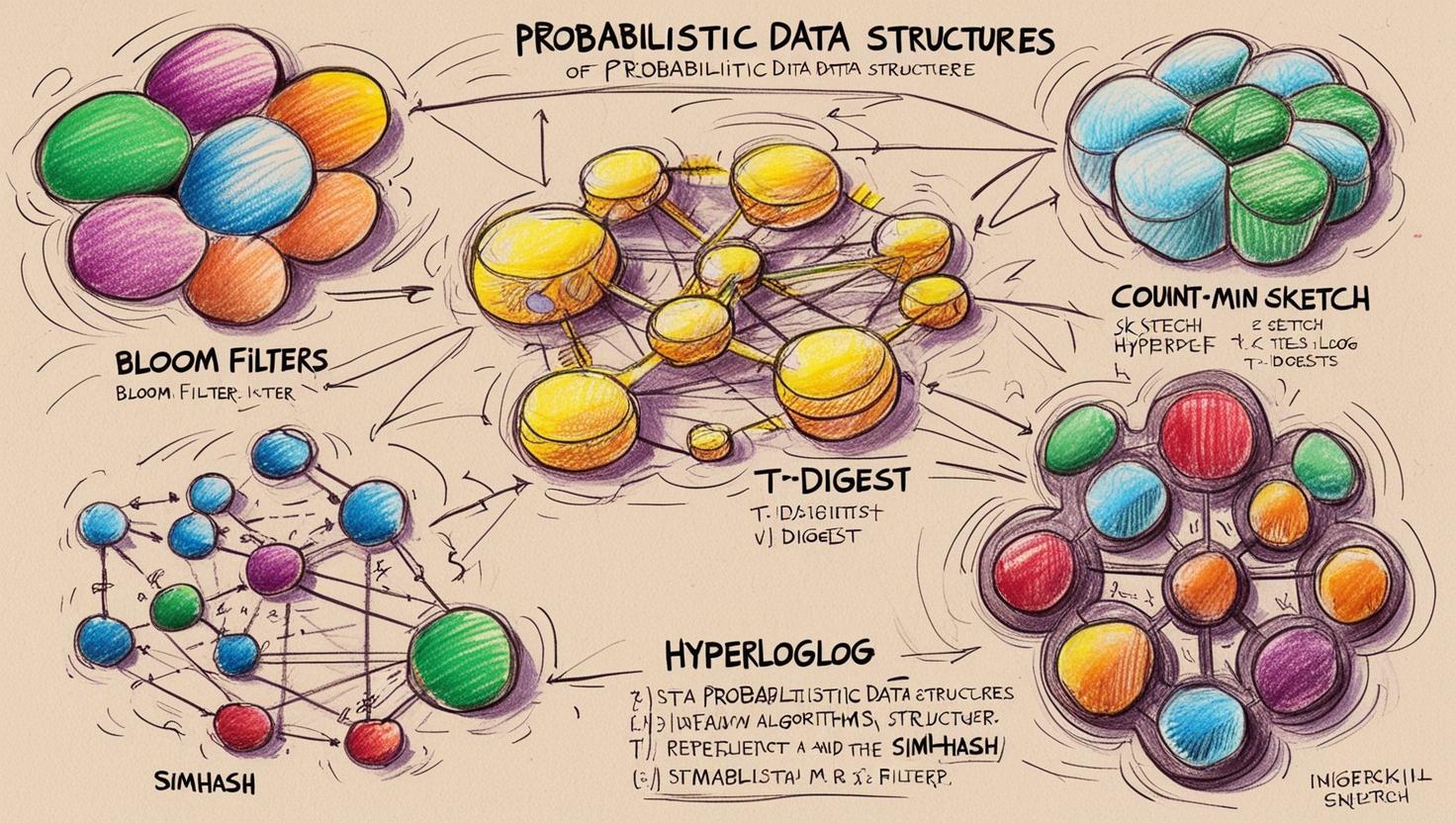
Efficient Algorithms for Approximate Computation in Large-Scale Systems
Efficiency over Determinism: The Rise of Approximate Data Structures
In an era where applications span continents, relying on intricate networks of microservices distributed across cloud-based servers, the traditional pursuit of absolute data accuracy faces significant obstacles. Imagine a global e-commerce platform processing millions of transactions per minute, with user data dispersed across data centers worldwide. Latency, inherent in these geographically dispersed systems, turns “now” into a relative concept. Each microservice operates independently, contributing to a constantly evolving data landscape where a unified, deterministic view is difficult to achieve.
Maintaining strong consistency in this dynamic environment requires complex coordination and synchronization, often sacrificing performance and scalability. Mirroring the trend in distributed databases, where eventual consistency models have gained prominence as pragmatic alternatives to the rigid ACID properties of traditional systems, there is a growing acceptance of approximation in the pursuit of efficiency.
Probabilistic data structures, with their inherent ability to embrace approximation, provide an elegant solution to this challenge. Just as distributed databases prioritize availability and partition tolerance over strict consistency, these innovative structures emerge as powerful alternatives to deterministic methods, especially when managing massive datasets under demanding performance requirements.
This article explores the motivations behind this trend, delves into the mechanics of probabilistic data structures, and examines their applications across diverse domains.
Foundations of Probabilistic Data Structures
Core Principles
Probabilistic data structures are designed to handle vast amounts of data efficiently by embracing approximation and leveraging probability. Unlike traditional data structures (trees, heaps or treaps), which aim for precise and deterministic answers, probabilistic structures are optimized for speed and memory efficiency, often at the expense of accuracy. This trade-off is invaluable in applications where exact answers aren’t critical, but performance and scalability are paramount.
Approximation and Probability
The fundamental concept behind these data structures is approximation—they produce results that are “good enough” rather than perfect. This is achieved by introducing controlled probability into the structure, allowing certain types of errors (like false positives or approximate counts) but ensuring these errors are minimal and predictable.
Imagine we have a system that needs to check quickly if an item is likely present in a large dataset. Rather than storing each item exactly, a probabilistic data structure can use a compact, approximate approach to make it very efficient, allowing for small, predictable errors. This is particularly useful in applications where memory and speed are prioritized over exact precision.
Let’s break down how adding and searching work in a general-purpose probabilistic data structure, using a bit array and hash functions to make these processes clear and tangible.
Example: Adding and Searching in a Probabilistic Data Structure
Step 1: Adding “apple”
- Apply Hash Functions to “apple”:
- Let’s assume our structure uses three hash functions: Hash1, Hash2, and Hash3. Each hash function takes the input “apple” and maps it to a position in the bit array.
- Mapping Positions in the Bit Array:
- Imagine a bit array that looks like this initially (all bits set to 0):
Bit Array: [0, 0, 0, 0, 0, 0, 0, 0, 0, 0]- Setting Bits:
- Hash1(“apple”) maps to position 2 → set bit at position 2 to 1.
- Hash2(“apple”) maps to position 5 → set bit at position 5 to 1.
- Hash3(“apple”) maps to position 7 → set bit at position 7 to 1.
After adding “apple,” the bit array might look like this:
Bit Array: [0, 0, 1, 0, 0, 1, 0, 1, 0, 0]Step 2: Searching for “apple”
- Apply Hash Functions to “apple” Again:
- To check if “apple” is present, we apply Hash1, Hash2, and Hash3 to “apple” and observe the corresponding positions in the bit array.
- Check Bits in Bit Array:
- Hash1(“apple”) maps to position 2 → bit at position 2 is 1.
- Hash2(“apple”) maps to position 5 → bit at position 5 is 1.
- Hash3(“apple”) maps to position 7 → bit at position 7 is 1.
Since all these bits are 1, we conclude that “apple” is probably present.
Step 3: Searching for “orange”
- Apply Hash Functions to “orange”: Now, we try searching for an item that hasn’t been added, say “orange.” We apply the same three hash functions:
- Hash1(“orange”) maps to position 3.
- Hash2(“orange”) maps to position 5.
- Hash3(“orange”) maps to position 8.
- Check Bits in Bit Array:
- Position 3 is 0 → This tells us that “orange” is definitely not present.
The Role of Probability in Approximation
Unlike traditional data structures, probabilistic data structures don’t store the actual data items. Instead, they use compact representations to indicate whether an item might be present, which dramatically reduces the memory requirements. Here’s how:
- Compact Bit Array Representation:
- Each item is represented by a few bits in a fixed-size bit array, not by storing the item itself.
- For example, a Bloom Filter can represent millions of items using only a few megabytes by relying on a fixed-size array rather than expanding memory for each item.
- Hash Functions as a Lightweight Approach:
- Hash functions quickly map items to specific bit positions without adding memory overhead.
- These functions “scatter” an item’s presence across the bit array in a controlled, predictable way.
- Eliminating Exact Storage:
- Unlike arrays or hash tables that store each item exactly, probabilistic structures only adjust bits in the array, keeping memory usage stable as more items are added.
- Allowing for Small, Controlled Errors:
- By permitting a slight margin of error, such as occasional false positives, the structure avoids precise tracking overhead, allowing high performance with low memory consumption.
But What If We Need the Full Data or Substrings?
In cases where we need access to the full data item or if the data might be a substring of a larger dataset, probabilistic data structures alone may not suffice. Here are some common strategies to extend their capabilities:
- Storing Full Data Separately:
- Probabilistic structures can serve as an efficient “front gate” check to see if data might exist, while the actual data is stored in a separate database or storage system.
- Example: If a Bloom Filter indicates that “apple” might be present, the system can then query a more detailed data source to retrieve the full “apple” record. This approach conserves resources by filtering out non-matches before accessing the main data store.
- Hybrid Approach with Hash Maps:
- A hybrid structure pairs a probabilistic filter with a hash map that stores the complete data, enabling efficient data retrieval when needed.
- Example: Once a Bloom Filter indicates a probable match, the system checks the hash map to retrieve the full data item
- Handling Substrings with Extended Probabilistic Structures:
- Modifications like prefix-based Bloom Filters can be implemented for substring or prefix searching by mapping segments of data. This is practical for fixed-length substring searches.
- Rolling Hashes can also be used to generate hash values for different data segments, enabling substring detection within large data streams. This method is especially useful in applications where variable-length substrings need to be identified.
As you can see, probabilistic data structures are designed for memory efficiency and fast presence checking. However, when full data retrieval or substring matching is required, they can be extended through hybrid systems or modified with techniques like prefix hashing or rolling hashes, ensuring both efficiency and data access.
The Magic of Hash Functions
Hash functions play a critical role in probabilistic data structures, acting as the transformers that convert data into unique, compact representations. By mapping data items to specific positions within a fixed space (often an array), hash functions enable fast data retrieval and storage, allowing for efficient and scalable solutions in large datasets.
┌─────────────────────────────────────┐
│          Add "apple"                │
└─────────────────────────────────────┘

               │
               │  (1) Input data item: "apple"
               │
               ▼
┌───────────────────────┐     ┌───────────────────────┐     ┌───────────────────────┐
│       Hash1           │     │       Hash2           │     │       Hash3           │
│ ───────────────────── │     │ ───────────────────── │     │ ───────────────────── │
│   Maps "apple" to     │     │   Maps "apple" to     │     │   Maps "apple" to     │
│      position 3       │     │      position 7       │     │      position 10      │
└───────────────────────┘     └───────────────────────┘     └───────────────────────┘

               │
               │
               │
               ▼
┌─────────────────────────────────────────────────────────────┐
│                            Bit Array                        │
│                                                             │
│       [ 0, 0, 1, 0, 0, 0, 1, 0, 0, 1, 0 ]                   │
│             ↑        ↑               ↑                      │
│       Position 3  Position 7      Position 10               │
│                                                             │
│ *Positions 3, 7, and 10 are set to 1 for "apple"*           │
└─────────────────────────────────────────────────────────────┘
Core Principles of Hash Functions
- Deterministic Output:
A hash function is deterministic, meaning that for a given input, it always produces the same output. This consistency is essential in probabilistic structures for reliably checking membership or frequencies. - Uniform Distribution:
A good hash function distributes inputs evenly across the output space. This reduces the chances of clustering, where multiple items map to the same position, which would increase the likelihood of errors (e.g., false positives). - Fixed Output Size:
Regardless of the input size, hash functions output a value of fixed length, allowing for efficient storage and easy access within data structures. This characteristic is key to keeping memory usage predictable.
Types of Hash Functions and Their Applications
- Simple Hash Functions:
- Modular Arithmetic (e.g.,
h(x) = x mod m): A basic and fast approach, ideal for simple use cases but less effective for large, complex datasets where clustering might occur. - Example: In a Bloom Filter, modular hash functions might quickly map items to specific positions in a bit array, providing a compact representation with minimal computational overhead.
- Modular Arithmetic (e.g.,
- Cryptographic Hash Functions (e.g., SHA-256):
- These functions produce highly unique outputs and are designed to be resistant to collisions (two inputs mapping to the same output). While they’re more computationally intensive, they provide excellent distribution.
- Example: Cryptographic hashes are often used in systems requiring strong security, but they’re less common in probabilistic data structures due to their higher computational cost.
- Universal Hash Functions:
- Universal hashing uses a family of hash functions and chooses one randomly for each operation, reducing clustering and improving distribution. This approach is especially useful for dynamic or high-traffic datasets.
- Example: Universal hashing can reduce false positive rates in Count-Min Sketches, enhancing their accuracy in frequency estimation.
How Hash Functions Enable Efficiency in Probabilistic Data Structures
- Fast Lookup and Storage: Hash functions allow for constant-time complexity, meaning that each operation (whether adding or searching) takes the same amount of time, regardless of the dataset size. This makes hash functions ideal for high-speed applications where performance is critical.
- Efficient Memory Usage: By representing data with a fixed output, hash functions help probabilistic structures use memory predictably and efficiently. The structure can scale to handle large datasets without needing additional memory for each item.
- Controlled Error Management: Hash functions manage false positives by distributing data uniformly, which minimizes overlaps. Probabilistic data structures typically use multiple hash functions, ensuring that even if one hash collides, the others likely won’t, keeping the error rate controlled.
Types of Problems They Solve
Membership Testing
Objective
Quickly determine if an item is possibly part of a large dataset without storing every item exactly, allowing occasional false positives (indicating an item is present when it’s not) but avoiding false negatives (missing items that are present).
Technique (Inserting “apple”)
- Data Item:
- Start with the item to be inserted, in this case, “apple.”
- Bit Array Fingerprint:
- Use a bit array to represent the dataset with 0s and 1s.
- Example Bit Array (before inserting “apple”):
[0, 0, 0, 0, 0, 0, 0, 0, 0, 0]- Hashing for Mapping:
- Apply multiple hash functions to “apple” to map it to specific positions in the bit array.
- Let’s say Hash1(“apple”) maps to position 2, Hash2(“apple”) to position 5, and Hash3(“apple”) to position 7.
- Setting Bits:
- Set the bits at these hashed positions (2, 5, and 7) to 1, indicating the possible presence of “apple.”
- Updated Bit Array:
[0, 0, 1, 0, 0, 1, 0, 1, 0, 0]Membership Check (Searching for “apple”)
- Apply Hashing for Positions:
- Use the same hash functions on “apple” to locate its corresponding bit positions.
- For “apple,” this would again be positions 2, 5, and 7.
- Check Bit Positions:
- If all bits at these positions (2, 5, and 7) are set to 1 → “apple” is likely present.
- If any of these bits is 0 → “apple” is definitely not present.
False Positives
- Occur when hash functions for different items map to the same bit positions.
- Acceptable in scenarios where a quick, approximate answer is sufficient.
Formula
The probability of a false positive can be approximated by:
P(false positive) ≈ (1 - e^(-kn/m))^k

where:
k: Number of hash functions
n: Number of items in the dataset
m: Size of the bit array
The false positive rate is influenced by the number of hash functions (k), the number of items in the dataset (n), and the size of the bit array (m). Increasing the number of hash functions or the size of the bit array can reduce the false positive rate, but it also increases the computational cost or memory usage.
Applications
- Spell Checkers: Quickly verifying if a word is in a dictionary.
- Databases: Preventing unnecessary lookups for non-existent data.
- Internet Routers: Efficiently filtering network traffic.
Cardinality Estimation
Objective
Estimate the number of unique items in a large dataset without counting each one precisely, allowing for an efficient approximation that requires minimal memory.
Technique
Imagine we have a partially filled bit array and want to insert “apple”:
- Bit Array before inserting “apple”:
[1, 0, 1, 1, 0, 1, 0, 0, 1, 0]- Hashing Process: Let’s say “apple” hashes to positions 1, 4, and 9.
- Uniqueness Check:
- If any of these positions are 0, “apple” likely contributes unique information, as it affects bits that haven’t been set yet.
- If positions 1, 4, and 9 are already 1, “apple” may not be unique, as it matches existing set bits, potentially from previous items.
False Positives
- Although the structure estimates the number of unique items, minor overestimations can occur due to hash collisions, especially as the bit array fills up.
- These false positives are acceptable in scenarios where an approximate count is sufficient, allowing for highly efficient memory usage.
Formula
The cardinality of unique items can be approximated based on the fullness pattern observed in the bit array:
Estimated Cardinality ≈ m / ϕ

where:
m: Total slots in the bit array.
ϕ: Fraction of empty slots remaining in the bit array.
This formula indicates that as the array fills up (fewer empty slots), the estimated number of unique items increases.
Applications
- Big Data Analytics: Estimate the number of unique users in a dataset without storing each ID.
- Streaming Data Processing: Track unique events, like clicks or logins, in real time.
- Database Query Optimization: Gauge the uniqueness of query results to optimize processing time.
Frequency Estimation
Objective
Estimate how often items occur within a large dataset, allowing for efficient tracking of high-frequency elements without exact counts for each item.
- Frequency is about the number of times each item appears (e.g., visits per user).
- Cardinality is about the number of unique items (e.g., unique visitors).
Technique (Inserting “apple”)
- Data Item:
- Begin with the item to be inserted, in this case, “apple.”
- Count Matrix:
- Use a compact matrix of counters to track frequency, typically two-dimensional where each row corresponds to a different hash function.
- If only one hash function were used, the counter at a single position could accumulate values from multiple items due to hash collisions.
- By using multiple hash functions and keeping a row for each, we distribute the counts across the matrix, generating multiple counters for each item and improving accuracy.
- This two-dimensional matrix is both compact and space-efficient, allowing approximate frequencies with less memory than exact counts would require.
Example Count Matrix (initially all counters set to 0):
Row 1: [0, 0, 0, 0, 0, 0, 0, 0, 0, 0]
Row 2: [0, 0, 0, 0, 0, 0, 0, 0, 0, 0]
Row 3: [0, 0, 0, 0, 0, 0, 0, 0, 0, 0]- Hashing for Counting:
- Apply multiple hash functions to “apple” to map it to specific positions in each row of the matrix.
- Let’s say:
- Hash1(“apple”) maps to position 2 in Row 1,
- Hash2(“apple”) maps to position 5 in Row 2,
- Hash3(“apple”) maps to position 7 in Row 3.
- Increment Counters:
- Increment the counters at each hashed position, reflecting the occurrence of “apple.”
Updated Count Matrix:
Row 1: [0, 0, 1, 0, 0, 0, 0, 0, 0, 0]
Row 2: [0, 0, 0, 0, 0, 1, 0, 0, 0, 0]
Row 3: [0, 0, 0, 0, 0, 0, 0, 1, 0, 0]
Frequency Check (Searching for “apple”)
- Apply Hashing for Positions:
- Use the same hash functions to locate “apple” in each row of the count matrix.
- Determine Estimated Frequency:
- Retrieve the counter values at each hashed position.
- Take the minimum of these values as the estimated frequency for “apple.”
- This approach minimizes the effects of any overestimations from individual collisions.
Estimated Frequency("apple") = min(Row 1, position 2; Row 2, position 5; Row 3, position 7)
                             = min(1, 1, 1)
                             = 1
Overestimation
- Overestimations may occur due to hash collisions, especially as more items are added.
- This is acceptable in real-time analysis, where quick, approximate frequency counts are prioritized over exact values.
Formula
The estimated frequency of an item x can be found by taking the minimum counter value across all hash functions:
Estimated Frequency(x) = min { C_h1(x), C_h2(x), ..., C_hk(x) }

where:
- C_hi(x) is the counter value at the position determined by hash function hi for item x.
Applications
- Real-Time Analytics: Track frequently accessed files, keywords, or errors in log files.
- Recommendation Systems: Identify trending items or popular topics for dynamic recommendations.
- Ad Targeting: Quickly identify high-frequency keywords or demographics in real-time data.
Quantile Estimation
Objective
Quantile estimation provides an approximate idea of how values are spread across a large dataset. It helps us identify specific percentiles, like the median (50th percentile) or 90th percentile, without needing to store or sort all values. This is especially useful for getting a rough distribution of data without excessive memory use.
Example Use Case
Imagine we’re tracking response times on a website, with each response time representing how long it took for the server to respond to a user’s request. We want to know the 90th percentile of these response times.
Assume we’ve recorded response times (in milliseconds) as follows:
Response Times: 120 ms, 95 ms, 200 ms, 80 ms, 150 ms, 300 ms, 250 ms, 130 ms, 110 ms, 175 msWhat the 90th Percentile Means
The 90th percentile response time is the time below which 90% of response times fall. In other words, only 10% of response times are slower than this value. This helps us understand how the slowest 10% of responses perform, which can be useful for identifying potential performance bottlenecks.
Intuitive Interpretation
Based on this concept, you can intuitively estimate that 90% of values are under 250 ms just by observing that most values fall below 250 ms. We have 10 values in total, so 90% of values would mean the first 9 values when ordered from shortest to longest response time. This quick check gives us a sense that 250 ms is a natural threshold—a point where only the slowest 10% of response times exceed this value.
For a small dataset, visually identifying the 90th percentile boundary is manageable, but for large datasets, we need automated mechanisms like probabilistic data structures.
Technique
- Dynamic Clusters (Centroids):
- Instead of keeping all data points, we group values into centroids, which are flexible clusters that represent ranges within the dataset.Each centroid records a range of values and the count of values that fall within that range, making centroids a compact representation of data distribution.
- Adding a New Value:
- When a new value arrives, we find the nearest centroid range.
- If the new value fits within an existing centroid, we expand its range and increase its count.
- If it doesn’t fit well with existing centroids, we create a new centroid, keeping centroids flexible and adaptable.
- Estimating a Percentile:
- To find a specific percentile (e.g., the 90th percentile), we sum counts across centroids until reaching the desired percentage of the total dataset.
- The range covered by the final centroid in this sum gives an approximate value for that percentile.
Applying Quantile Estimation to Our Response Time Example
Let’s apply quantile estimation to our response time example to approximate the 90th percentile using centroids instead of the intuitive approach.
Response Times: 120 ms, 95 ms, 200 ms, 80 ms, 150 ms, 300 ms, 250 ms, 130 ms, 110 ms, 175 ms- Adding Values to Centroids:
- We start with an empty list of centroids and add each response time one by one.
- For simplicity, let’s set a limit of 4 centroids to keep things compact, so centroids will adjust or merge as needed.
- Forming Centroids:
- Insert each response time, grouping close values together.
- If a new value fits a centroid’s range, expand that range and increase its count; otherwise, create a new centroid.
- Final Centroids:
Centroid 1: [110-175], Count 5
Centroid 2: [80-95], Count 2
Centroid 3: [200-250], Count 2
Centroid 4: [300-300], Count 1- Estimating the 90th Percentile
- Total Count: Sum of counts in centroids = 10.
- Calculate 90th Percentile Position: 90% of 10 is 9, so we need the 9th value in the cumulative counts.
- Sum Cumulative Counts Across Centroids:
- Centroid 1: Cumulative count = 5 (still below 9).
- Centroid 2: Cumulative count = 7 (still below 9).
- Centroid 3: Cumulative count = 9 (reaches the 9th value).
- Result:
- The 90th percentile falls within Centroid 3’s range of
[200-250]ms, meaning 90% of response times are below approximately 250 ms.
- The 90th percentile falls within Centroid 3’s range of
False Positives
Since centroids are clusters, they may include values that aren’t perfectly accurate for every range. This can cause minor inaccuracies (or “false positives”), but this is acceptable for a rough estimate as centroids keep memory use low and processing fast.
Applications
- Performance Monitoring: Approximate response times for percentiles, like finding the slowest 10% of responses (e.g., the 90th percentile of response times).
- Financial Analysis: Estimate top percentiles of stock price movements to understand extreme market values.
- User Behavior Analysis: Determine the median activity level (50th percentile) or identify the most active 10% of users.
Similarity Search
Objective
Similarity search aims to quickly find items in a dataset that are “similar” to a given query item. Instead of finding exact matches, it locates items that closely resemble the query based on specific characteristics. This is especially useful for large datasets, where manually comparing every item would be too slow.
Example Use Case
Imagine a music recommendation system. When a user likes a particular song, we want to suggest similar songs based on characteristics like genre, tempo, or mood—without comparing every song in the database.
Technique: Locality-Sensitive Hashing (LSH)
LSH maps items to “buckets” based on shared characteristics, so items with similar features are more likely to be placed in the same or neighboring buckets. This arrangement makes it easier to locate similar items quickly.
- How It Works:
- Each item (e.g., a song) is transformed into a vector of characteristics (like genre, tempo, and mood scores).
- Hash functions then map these vectors to specific buckets based on their similarities.
- When searching for similar items, we only look within the bucket (or nearby buckets) where the query item is located, significantly speeding up the search.
Example with Songs and Buckets
Consider the following songs, each with attributes like genre, tempo, and mood:
Song A: [Pop, 120 BPM, Happy]
Song B: [Jazz, 90 BPM, Calm]
Song C: [Pop, 125 BPM, Happy]
Song D: [Classical, 80 BPM, Calm]
Song E: [Pop, 130 BPM, Energetic]
Each song is represented as a vector:
Song A: [1, 120, 1]
Song B: [2, 90, 2]
Song C: [1, 125, 1]
Song D: [3, 80, 2]
Song E: [1, 130, 3]
Here, numbers represent genre (1 for Pop, 2 for Jazz, etc.), BPM, and mood (1 for Happy, 2 for Calm).
Using LSH, similar songs are hashed into buckets based on their features. Here’s an example of how buckets might be arranged:
Bucket 1 (Pop, Happy): [Song A, Song C]
Bucket 2 (Pop, Energetic): [Song E]
Bucket 3 (Jazz, Calm): [Song B]
Bucket 4 (Classical, Calm): [Song D]
Searching for Similar Songs:
- If a user likes Song A (
[Pop, 120 BPM, Happy]), we quickly locate similar songs, Song C and Song E, by checking within Bucket 1 (Pop, Happy) and Bucket 2 (Pop, Energetic). - This approach avoids searching the entire dataset, saving both time and computational resources.
False Positives
Because LSH approximates similarities, it can produce false positives—items that appear similar but aren’t closely matched on every feature. However, these minor inaccuracies are generally acceptable in exchange for faster, memory-efficient searches.
Applications
- Music or Video Recommendations: Suggest songs or videos that resemble a user’s past favorites based on shared attributes.
- Image and Document Retrieval: Quickly locate images or documents with similar content, used in search engines or photo libraries.
- Fraud Detection: Identify transactions or user behaviors that resemble known fraudulent patterns, based on similarity in data characteristics.
Membership Testing: Bloom Filters
Why Use Bloom Filters?
Bloom filters are a compact, memory-efficient data structure ideal for applications that require rapid, probabilistic membership testing rather than absolute accuracy. Unlike traditional structures like hash tables or arrays, Bloom filters allow you to determine if an element might be in a set without storing the entire dataset. However, Bloom filters can yield false positives but never false negatives, making them highly suitable for high-scale applications where memory efficiency and quick lookups are crucial.
Choosing and Configuring Hash Functions
For Bloom filters, hash functions should be both independent and uniformly distributed to avoid clustering and ensure even distribution across the bit array. The hash functions should also be lightweight for performance. Cryptographic hash functions (e.g., SHA1) are not ideal as they are slower. Common choices include:
- Murmur Hash: Fast and uniform distribution, commonly used in databases and large datasets.
- xxHash: Known for high speed and reliability in large datasets.
- FNV (Fowler-Noll-Vo): Suitable for smaller applications requiring simple, fast hashing.
To illustrate the impact of faster hashing, switching from MD5 to Murmur has been shown to yield performance increases of up to 800% in certain applications.
Sizing Your Bloom Filter
One of the advantages of Bloom filters is their adjustable false positive rate, which you can tune by controlling the filter size and number of hash functions. The false positive rate is approximately:
P(false positive) ≈ (1 - e^(-kn/m))^k

where:
k = number of hash functions,
n = number of expected elements,
m = size of the bit array.
Larger bit arrays reduce false positives, while smaller arrays increase them. For efficient tuning, estimate the values of n, m, and k based on your application’s capacity and tolerance for false positives.
Optimizing the Number of Hash Functions
The number of hash functions, k, influences both the Bloom filter’s speed and its capacity for accurate checks. Too few hash functions increase false positives, while too many slow down insertions and checks. To find the optimal number of hash functions given m and n, use:
k = (m/n) * ln(2)This allows for an efficient trade-off between the size of the Bloom filter and the acceptable error rate. Steps for configuring a Bloom filter:
- Estimate n (expected dataset size).
- Choose m (bit array size).
- Calculate k.
- Adjust m as needed to meet the desired error rate.
Performance and Space Efficiency
For a Bloom filter with m bits and k hash functions:
- Time Complexity: Each insertion and lookup is O(k), making it efficient, especially when k is small.
- Space Complexity: Bloom filters use a fraction of the memory compared to exact data structures, typically needing around 9.6 bits per element for a 1% false positive rate.
Bloom filters are ideal for scenarios with limited memory and when an approximate membership check is sufficient. For datasets with unknown or unbounded size, alternatives like scalable Bloom filters or hash tables may be more appropriate.
Real-World Applications
Bloom filters are widely adopted for fast membership testing in high-traffic systems, saving time and reducing memory demands. Notable applications include:
- Redis:
- Source: Source Code
- Usage:
- RedisBloom employs Bloom filters for rapid membership checks across large datasets, using Murmur for efficient hashing.
- Chromium:
- Source: Source Code
- Usage:
- Uses Bloom filters for URL and data filtering within its optimization guide, leveraging Murmur for uniform hashing.
- Apache Spark:
- Source: Source Code
- Usage:
- Spark incorporates Bloom filters to streamline data loading, avoiding redundant data and enhancing performance with Murmur hash.
- RocksDB:
- Source: Source Code
- Usage:
- RocksDB optimizes disk lookups with Bloom filters, employing xxHash3 for efficient, high-performance data handling.
- ScyllaDB:
- Source: Source Code
- Usage:
- ScyllaDB utilizes Bloom filters with Murmur for faster data retrieval, ideal for high-performance database management.
These applications demonstrate how Bloom filters provide memory-efficient, probabilistic membership testing, often powered by hash functions like Murmur and xxHash3, tailored to high-throughput environments.
Cardinality Estimation: HyperLogLog
Why Use HyperLogLog?
HyperLogLog is a highly efficient, memory-saving algorithm designed to solve the Cardinality Estimation Problem—estimating the number of unique elements within massive datasets. Unlike exact counting methods, which require significant memory and time, HyperLogLog enables quick, approximate cardinality estimates with a small, controllable error rate. Its extreme efficiency makes it ideal for large-scale applications, where precise counts are less crucial than rapid, approximate results.
HyperLogLog’s approach is particularly advantageous for real-time analytics, where even a slight error tolerance is acceptable. It optimizes both time and space by condensing large datasets into a compact register array, saving resources and speeding up computation.
Configuring HyperLogLog
To configure HyperLogLog effectively, it’s essential to understand its reliance on hashing and bucket-based counting.
- Hashing: HyperLogLog uses hash functions to transform each input into a uniformly distributed binary number. The algorithm then counts the leading zeroes in each hash result, using this value as a probabilistic indicator of the unique element count.
- Registers (m): HyperLogLog splits hash values across m registers (small memory segments), using the first few bits to assign each hash result to a register and the remaining bits for the count.
Core Formula for Cardinality Estimate:
E ≈ α * m^2 / Σ(2^(-Rj))

where:
E = estimated cardinality
α = bias-correction constant (dependent on m)
m = number of registers (buckets)
Rj = number of leading zeroes in the j-th hashed value
Steps for Tuning HyperLogLog
- Choose the Register Count (m): Increasing m improves accuracy but requires more memory. Common configurations for typical applications range from 64 to 16,384 registers.
- Set the Bias Correction (α): Use a pre-calculated α factor, specific to m, to balance out systematic biases in the estimation.
- Optimize Hashing: Select a consistent and efficient hash function, such as Murmur or xxHash, for an even distribution across registers.
HyperLogLog achieves an error rate of about 1.04/√m, making it highly efficient for approximating counts with a 2% error rate at a low memory footprint.
Performance and Space Efficiency
HyperLogLog’s compact structure enables it to handle vast amounts of data efficiently.
- Time Complexity: For each element, HyperLogLog performs a constant-time hash operation, resulting in an O(1) insertion time.
- Space Complexity: With a minimal space requirement, HyperLogLog uses around 1.5 KB of memory to count over a billion unique items with a 2% error rate.
The algorithm’s efficiency allows it to tackle the cardinality problem in a fraction of the memory used by traditional methods, without compromising on speed.
Real-World Applications of HyperLogLog
HyperLogLog is widely adopted across platforms where large-scale, unique counts are critical:
- Amazon Redshift:
- Source: Documentation
- Usage:
- HyperLogLog powers Redshift’s
APPROXIMATE COUNT DISTINCT, supporting quick cardinality estimations on massive datasets while conserving memory. This allows Redshift users to run efficient approximate queries.
- HyperLogLog powers Redshift’s
- ScyllaDB:
- Source: Source Code
- Usage:
- Used within ScyllaDB’s SSTable management, HyperLogLog estimates unique key counts, optimizing resource use for high-speed, distributed data storage.
- Redis:
- Source: Documentation | Source Code
- Usage:
- Redis integrates HyperLogLog with commands like
PFADDandPFCOUNT, enabling approximate cardinality estimations without increasing the memory footprint, ideal for large-scale datasets.
- Redis integrates HyperLogLog with commands like
- Facebook and Google BigQuery:
- Source: Facebook Engineering Post | Google Blog
- Usage:
- Facebook and Google employ HyperLogLog for distinct counts on user interactions, supporting real-time analytics and optimizing database performance in systems like Presto and BigQuery.
These applications showcase HyperLogLog’s impact on modern, large-scale data systems, where efficient, approximate distinct counts are essential to performance and resource management.
Frequency Estimation: Count-Min Sketch
Why Use Count-Min Sketch?
Count-Min Sketch is a highly efficient, probabilistic data structure used to estimate the frequency of elements within a data stream. Unlike exact counting structures, Count-Min Sketch uses hash-based counters to approximate frequencies with a small memory footprint, making it ideal for high-speed applications where an exact count isn’t required but quick and approximate results are beneficial. This trade-off allows for minor inaccuracies (overestimates) but ensures fast, memory-efficient performance in high-scale systems.
Core Formula for Frequency Estimation:
To estimate the frequency f of an element x, the Count-Min Sketch uses multiple hash functions and selects the minimum value across multiple counters:
f(x) ≈ min(C[h1(x)], C[h2(x)], ..., C[hk(x)])

where:
- C[h1(x)], C[h2(x)], ..., C[hk(x)] are counters in a table where each hash function maps x to a specific counter.
- k is the number of hash functions used, each mapping to a different counter.
By choosing the minimum value across multiple counters, we limit the overestimation introduced by hash collisions.
Configuring Count-Min Sketch
Determining Parameters
The two main parameters in a Count-Min Sketch are:
- Width (w): Controls the number of counters per hash function and directly impacts the error bound. Increasing w reduces the probability of overestimation by spreading elements across more counters.
- Depth (d): The number of hash functions used, controlling the probability of large errors. Increasing d improves accuracy but requires additional memory.
Error Bounds
The error in Count-Min Sketch is controlled by both width and depth:
Relative Error (ε): Width
w = ⌈e / ε⌉ limits the overestimation to a factor of ε.

Failure Probability (δ): Depth
d = ⌈ln(1 / δ)⌉ bounds the error probability to within δ.
Together, w and d are configured to balance memory efficiency with an acceptable error rate for the application.
Example Parameters
For an error tolerance of 5% (ε = 0.05) and failure probability of 1% (δ = 0.01):
Width (w) = ceil(e / ε) = 55
Depth (d) = ceil(ln(1 / δ)) = 5
This configuration would produce a Count-Min Sketch that approximates frequencies with 5% relative error and a 1% probability of significant overestimation.
Performance and Space Efficiency
Time Complexity: Each insertion and query is O(d), due to the need to hash and update counters across all hash functions.

Space Complexity: Space is O(w * d), allowing Count-Min Sketch to scale with a fixed memory footprint relative to error tolerance and failure probability.
Count-Min Sketch provides a powerful alternative for large-scale, high-speed frequency estimation where absolute accuracy is unnecessary. Its efficiency and small memory footprint make it ideal for high-throughput applications like network monitoring, search engines, and recommendation systems.
Real-World Applications of Count-Min Sketch
Count-Min Sketch is widely used in systems where fast, approximate frequency estimation is essential:
- Redis:
- Source: Redis Documentation on Count-Min Sketch | Redis Blog: Count-Min Sketch – Art and Science of Estimating
- Usage: Utilizes Count-Min Sketch for quickly estimating the frequency of large data items with high speed and reduced memory overhead.
- Network Traffic Analysis: Used to monitor high-frequency packets, detect heavy hitters, and prevent network congestion.
- E-commerce and AdTech: Estimates the popularity of products and ads in real-time, enabling rapid adjustments in inventory or ad placements.
Quantile Estimation: t-digest
Why Use t-digest?
In large-scale data systems, quickly and accurately estimating quantiles (such as medians or specific percentiles) is essential for understanding data distribution, detecting anomalies, and tracking performance. Traditional quantile calculation methods require storing and sorting all data points, which can be computationally expensive and memory-intensive, especially for streaming or real-time applications.
t-digest, a probabilistic data structure, offers a powerful solution to this problem by providing a compact, memory-efficient way to estimate quantiles with high accuracy, even in skewed distributions. Unlike fixed histogram-based methods, t-digest adapts to data patterns, maintaining precision in the distribution tails where accuracy is often most needed.
Key benefits of t-digest include:
- Memory Efficiency: Uses bounded memory, allowing it to process massive datasets without scaling issues.
- Accuracy at Distribution Tails: Prioritizes precision for extreme quantiles, making it ideal for applications where tail data (e.g., 90th or 99th percentiles) holds critical insights.
- Real-Time Performance: Offers fast insertion and query times, allowing quantile estimation in real-time or near real-time for high-throughput data environments.
t-digest is particularly useful in monitoring systems, financial applications, and high-performance analytics, where both memory efficiency and accuracy for tail-based data insights are essential.
Core Concept and Configuration
t-digest is designed to accurately estimate quantiles by intelligently clustering data points into centroids. Each centroid represents a group of data points with similar values, summarized by their mean and weight (the number of points in the centroid). The key to t-digest‘s efficiency and accuracy lies in how it manages these centroids, particularly focusing on providing higher resolution (more centroids) where it’s most needed—typically at the tails of the distribution.
Compression Parameter (δ)
The Compression Parameter (δ) is a crucial setting in t-digest that controls the overall number of centroids, directly affecting memory usage and accuracy:
- Higher δ Values: Allow for more centroids, increasing accuracy, especially in the tails, but consume more memory.
- Lower δ Values: Reduce the number of centroids, saving memory at the cost of reduced accuracy.
The approximate relationship between δ, the number of centroids (C), and the total number of data points (N) is:
C = δ * log(N)

where:
C: Number of centroids.
δ: Compression parameter.
N: Total number of data points.
This formula indicates that as δ increases, the number of centroids grows logarithmically with N, enhancing the digest’s ability to represent the data distribution accurately.
Scaling for Tail Accuracy
To prioritize accuracy in the distribution tails, t-digest employs a scaling function that adjusts the allowable size of centroids based on their quantile position. This means centroids near the median can be larger (less precise), while those near the tails are smaller (more precise).
The scaling function S(q) is defined as:
S(q) = δ * min(q, 1 - q)

where:
- S(q): Scaling function determining the cumulative weight allowed up to quantile q.
- q: The quantile rank (ranging from 0 to 1).
This function ensures that the cumulative weight (sum of centroid weights) up to any quantile q does not exceed S(q), effectively controlling centroid sizes:
- Near the median (q ≈ 0.5): S(q) is maximized, allowing larger centroids since less precision is acceptable.
- Near the tails (q → 0 or q → 1): S(q) approaches zero, enforcing smaller centroids for higher precision.
How δ and Scaling Work Together
The Compression Parameter (δ) and Scaling Function S(q) are interdependent:
- δ sets the overall compression level, influencing how many centroids can exist in total.
- S(q) uses δ to determine the maximum cumulative weight at each quantile, effectively distributing the available centroids unevenly—more where precision is critical (tails) and fewer where it’s less so (center).
This relationship ensures that t-digest allocates more centroids to areas requiring higher accuracy without exceeding the total number of centroids allowed by δ.
Imagine the quantile range from 0 to 1 along the x-axis:
- The scaling function S(q) forms a triangle, peaking at the median (q = 0.5) and tapering to zero at the tails (q = 0 and q = 1).
- The area under the curve represents the total cumulative weight allowed, controlled by δ.
Algorithm Mechanics
Data Insertion:
- Each new data point is mapped to its quantile estimate based on existing centroids.
- The algorithm identifies where in the quantile range the data point falls and determines the allowable centroid size using S(q).
Centroid Allocation:
- If the nearest centroid’s weight doesn’t exceed the allowable size at that quantile, the data point is merged into it.
- If adding the data point would exceed the allowable weight, a new centroid is created.
Centroid Merging:
- Periodically, centroids are merged to maintain the overall count within the limits set by δ.
- Merging respects the scaling function, ensuring that centroids near the tails remain small.
Formula for Quantile Estimation
To estimate a quantile value (e.g., the value at the 90th percentile), t-digest performs:
Q(q) ≈ interpolate between centroids enclosing cumulative weight = q * N

where:
- Q(q): Estimated value at quantile q.
- N: Total number of data points (sum of all centroid weights).
- Interpolate: Linear interpolation between the means of centroids just below and above the desired cumulative weight.
Suppose you want to estimate the 95th percentile:
- Calculate target cumulative weight:
W_target = 0.95 * N. - Traverse centroids in order, summing their weights until the cumulative weight just exceeds W_target.
- Interpolate between the centroids where W_target falls to estimate the 95th percentile value.
Real-World Applications
t-digest’s compact yet accurate structure is widely implemented across systems needing efficient quantile estimations for both streaming and stored data. Here are some prominent applications:
- Redis
- Source: Redis Documentation
- Usage:
- Built into Redis Stack as a probabilistic data structure for real-time percentile and quantile queries.
- Applications include monitoring and analytics for metrics like server latency and user behavior.
- Apache Druid
- Source: Apache Druid Documentation
- Usage:
- Integrates t-digest sketches for percentile aggregations on large, streaming datasets.
- Applications include real-time analytics for petabyte-scale data.
- Elasticsearch
- Source: Elasticsearch Documentation
- Usage:
- Supports percentile aggregations via t-digest to provide efficient and approximate calculations.
- Applications include analytics on large datasets where memory efficiency is critical.
Similarity Search: LSH-Based Types
Locality-Sensitive Hashing (LSH) enables approximate similarity searches for high-dimensional data by mapping similar items to the same “bucket” with high probability. Next, we will explore some LSH types: SimHash and Min-Hash.
SimHash
Why Use SimHash?
SimHash is particularly effective for applications requiring cosine similarity measures, such as identifying near-duplicate documents in text-heavy environments. By converting documents into compact binary hashes, SimHash preserves document similarity, making it highly efficient for large-scale applications, including search engines, social media, and plagiarism detection.
Step-by-Step Implementation of SimHash for Document Similarity
Here’s a practical guide to implementing SimHash for detecting near-duplicate documents, from processing a document file to measuring similarity.
Step 1: Convert Documents to Feature Vectors
Transform each document into a feature vector:
- Tokenize the document by splitting it into individual words.
- Remove stopwords (e.g., “the,” “is,” “and”) to focus on meaningful terms.
- Count word occurrences to create a term frequency vector.
Example:
Document: "The quick brown fox jumps over the lazy dog."

Tokens after stopwords removal: ["quick", "brown", "fox", "jumps", "lazy", "dog"]

Term frequency vector: {"quick": 1, "brown": 1, "fox": 1, "jumps": 1, "lazy": 1, "dog": 1}
Step 2: Assign a Hash Value to Each Word
Each word is hashed to a fixed-length binary string (e.g., 64 or 128 bits). For instance:
quick   -> 1010101010111010...
brown   -> 1101101010101011...
Step 3: Weighted Hash Vector
For each bit in the hash:
- Sum the weighted values across all words, using positive values if the bit is
1and negative values if the bit is0. - Multiply each bit by the word’s frequency to create a weighted vector.
For example:
Word: "quick"   Hash: 1010...
Weighted vector for "quick": [+1, -1, +1, -1, ...]
Word: "brown"   Hash: 1101...
Weighted vector for "brown": [+1, +1, -1, +1, ...]
Final weighted vector: [+2, 0, 0, 0, ...]
Step 4: Construct the SimHash
Convert the weighted vector into the SimHash: Assign 1 if the sum of values at each bit position is positive, and 0 if negative.
Example:
Weighted vector: [+2, 0, 0, -1, ...]
SimHash:         1  1  1  0  ...
Step 5: Compare SimHashes to Detect Similarity
- Calculate Hamming Distance: Compare the SimHash of two documents by counting the number of differing bits.
- Set a Similarity Threshold: Define a threshold (e.g., 3 or fewer differing bits) to classify documents as near-duplicates.
Example:
Document A SimHash: 10101100
Document B SimHash: 10101000
Hamming Distance: 1 (indicating high similarity)
Workflow Summary
- Read two document files (e.g.,
doc1.txtanddoc2.txt). - Convert each document to a vector, hash terms, and calculate weighted vectors.
- Compute SimHash for each document.
- Compare Hamming distance between the two SimHashes.
- If the distance is below a threshold, classify the documents as near-duplicates.
Real-World Applications of SimHash for Document Similarity
- Search Engines: Detect and eliminate duplicate content in web crawling.
- Social Media & News Aggregation: Group similar articles or posts for streamlined feeds.
- Plagiarism Detection: Identify copied or slightly altered content.
Min-Hash
Why Use Min-Hash?
Min-Hash is a specialized technique for estimating Jaccard similarity between sets. It’s particularly suited for applications where documents or items can be broken down into distinct, unordered elements (e.g., words, tags, or unique identifiers). This makes it ideal for set-based similarity detection tasks, such as document deduplication, where we want to know how many unique elements two documents have in common relative to their total number of elements.
Step-by-Step Implementation of Min-Hash for Document Similarity
Follow these steps to implement Min-Hash for detecting similarity between documents, from initial set conversion to measuring Jaccard similarity.
Step 1: Convert Documents to Shingle Sets
A shingle is a small, contiguous sequence of words (or characters) extracted from a document. It’s used to represent the document in smaller chunks, making it easier to analyze structural similarities between texts. Shingles capture the context of words, which helps to better identify similarities and differences between documents, especially when comparing word order or phrasing.
Example:
Document: "The quick brown fox jumps."

Shingle set (bigrams): {"The quick", "quick brown", "brown fox", "fox jumps"}
Step 2: Apply Hash Functions to Each Shingle
For Min-Hashing:
- Generate multiple hash functions (e.g.,
h1,h2,h3) that will map each shingle to a random integer. - For each document, apply each hash function to every shingle.
Example:
Shingle: "The quick"

Hash values: h1("The quick") = 5, h2("The quick") = 20, h3("The quick") = 11
Step 3: Compute Min-Hash Signatures
Build the Min-Hash signature for each document:
- For each hash function, record the smallest hash value produced by any shingle in the document’s set.
- This smallest value (minimum hash) represents the document for that hash function.
Example:
Document A Shingles: {"The quick", "quick brown", "brown fox"}
Hash function h1 values: 5, 15, 8 (min value: 5)
Hash function h2 values: 20, 7, 12 (min value: 7)
Hash function h3 values: 11, 3, 6 (min value: 3)

Min-Hash Signature for Document A: [5, 7, 3]
Step 4: Compare Min-Hash Signatures for Similarity
To estimate similarity:
- Calculate Signature Similarity: Compare the Min-Hash signatures of two documents by counting the number of identical positions in their signatures.
- Estimate Jaccard Similarity: The fraction of matching hash values between two Min-Hash signatures approximates the Jaccard similarity between the original sets.
Example:
Document A Min-Hash Signature: [5, 7, 3]
Document B Min-Hash Signature: [5, 8, 3]

Matching positions: 2/3 (66% similarity)
Workflow Summary
- Convert each document to a set of shingles (e.g., bigrams or trigrams).
- Apply multiple hash functions to each shingle in the set.
- Build Min-Hash signature by recording the minimum hash values for each hash function.
- Compare Min-Hash signatures to estimate Jaccard similarity.
SimHash vs. Min-Hash
Consider two text documents where we want to measure their similarity. Here’s how each approach would interpret the similarity:
SimHash (Cosine Similarity)
- Measures the angle (cosine) between two document vectors based on word frequency.
- Useful when documents are similar in content but may contain slight differences in word count or frequency.
- For example, if we compare:
- Document 1: “The quick brown fox jumps over the lazy dog.”
- Document 2: “Quick brown fox jumps over a lazy dog.”
SimHash would consider these two documents highly similar because the main words and their relative importance (frequency) are nearly identical.
Min-Hash (Jaccard Similarity)
- Measures the overlap of unique elements (e.g., unique words or shingles) between two sets.
- Useful when we’re interested in exact matches of elements rather than their relative importance.
- For example:
- Document 1 Shingles (trigrams): {“The quick brown”, “quick brown fox”, “brown fox jumps”}
- Document 2 Shingles (trigrams): {“Quick brown fox”, “brown fox jumps”, “fox jumps over”}
Min-Hash would find these documents less similar than SimHash because the sets of shingles have less overlap, even though the overall content is similar.
By focusing on Jaccard similarity, Min-Hash is more effective in scenarios where exact element overlap (set-based similarity) matters more than the relative weighting or frequency of terms, as used in SimHash.
Real-World Applications of Min-Hash
- Document and Web Page Deduplication: Identify and filter out duplicate or near-duplicate pages in search engine indexing.
- Social Media and News Aggregation: Group similar content or articles.
- Collaborative Filtering: Cluster users or items with overlapping features, such as shared preferences.
- Genomic Analysis: Detect similarities in DNA sequences by treating them as sets of k-mers (small sequences).
Other LSH-Based Types
In addition to the widely used LSH-based types such as SimHash and Min-Hash, there are also other advanced LSH techniques tailored for specific use cases:
- Random Hyperplane LSH: This method is ideal for detecting high-dimensional cosine similarity. It’s applied extensively in text document clustering and recommendation systems, where large, sparse data vectors are analyzed for similarity based on angle rather than magnitude.
- Cross-Polytope LSH: Effective for both Euclidean and angular distances, Cross-Polytope LSH is applied in scenarios like high-speed similarity searches in large-scale datasets and fraud detection in financial systems, providing accurate hashing for very high-dimensional spaces.
These techniques expand the scope of LSH applications, making it possible to perform efficient similarity searches across various types of high-dimensional data.
Ordered Sets: Skip Lists
Why Use Skip Lists?
Skip lists are an efficient, probabilistic data structure designed for ordered data storage and retrieval. They offer similar time complexities to balanced trees but are simpler to implement, leveraging randomness to maintain order without complex rebalancing. Skip lists are especially useful for applications where fast insertion, deletion, and search in ordered sets are essential, such as in-memory databases, search engines, and priority queues.
Core Concept and Configuration
A skip list consists of multiple linked lists layered on top of each other, with each level “skipping” over several elements. The base layer is a regular linked list containing all elements in sorted order. Each higher level contains a subset of elements from the lower level, enabling faster traversal by skipping over sections of the list.
Key Parameters:
- Probability Factor (p): Determines the likelihood of an element being included in a higher level. Common choices are p = 0.5 or p = 0.25.
- Maximum Level (L): Sets the maximum number of levels, usually based on the logarithm of the number of elements, allowing efficient search times.
Time Complexities:
- Insertion/Deletion/Search: Average O(log n), Worst-case O(n).
JavaScript Implementation of SkipList
Structure
The SkipList structure consists of nodes organized in multiple levels, where each node maintains forward pointers to subsequent nodes at various levels. Each node’s level is determined probabilistically to maintain a balance between time efficiency and memory usage.
- Node Class: Represents an individual node in the skip list, storing the value and forward pointers.
- SkipList Class: Manages the nodes and implements the core functionality (insertion, search, and deletion).
// Node class for skip list
class Node {
    constructor(value, level) {
        this.value = value;
        this.forward = new Array(level + 1).fill(null);
    }
}
// Skip List class
class SkipList {
    constructor(maxLevel, probability) {
        this.maxLevel = maxLevel;          // Maximum level of skip list
        this.probability = probability;     // Probability for node level
        this.level = 0;                     // Current level of skip list
        this.head = new Node(null, maxLevel); // Head node
    }
    // Random level generator based on probability
    randomLevel() {
        let level = 0;
        while (Math.random() < this.probability && level < this.maxLevel) {
            level++;
        }
        return level;
    }
}
Insertion
To insert a value, we determine where it should go by moving through each level of the skip list. After locating the insertion points, a new node is created with a random level, and its pointers are set accordingly.
insert(value) {
    let update = new Array(this.maxLevel + 1).fill(this.head);
    let current = this.head;
    // Move through levels to find insert position
    for (let i = this.level; i >= 0; i--) {
        while (current.forward[i] && current.forward[i].value < value) {
            current = current.forward[i];
        }
        update[i] = current;
    }
    // Generate a random level for this node
    const newLevel = this.randomLevel();
    // If new level is greater than current level, update list level
    if (newLevel > this.level) {
        for (let i = this.level + 1; i <= newLevel; i++) {
            update[i] = this.head;
        }
        this.level = newLevel;
    }
    // Insert new node at each level up to newLevel
    const newNode = new Node(value, newLevel);
    for (let i = 0; i <= newLevel; i++) {
        newNode.forward[i] = update[i].forward[i];
        update[i].forward[i] = newNode;
    }
    console.log(`Inserted ${value} at level ${newLevel}`);
}
Search
The search operation works by moving from the highest level to the lowest level, stopping when we find the target value or reach the end of the list.
search(value) {
    let current = this.head;
    for (let i = this.level; i >= 0; i--) {
        while (current.forward[i] && current.forward[i].value < value) {
            current = current.forward[i];
        }
    }
    current = current.forward[0];
    if (current && current.value === value) {
        console.log(`Found ${value}`);
        return true;
    } else {
        console.log(`${value} not found`);
        return false;
    }
}
Deletion
Deletion in a skip list involves updating pointers at each level to bypass the node to delete. After removing the node, we may need to adjust the levels to remove any empty levels at the top.
delete(value) {
    let update = new Array(this.maxLevel + 1).fill(null);
    let current = this.head;
    // Find nodes to update at each level
    for (let i = this.level; i >= 0; i--) {
        while (current.forward[i] && current.forward[i].value < value) {
            current = current.forward[i];
        }
        update[i] = current;
    }
    // Move to the target node in base level
    current = current.forward[0];
    if (current && current.value === value) {
        for (let i = 0; i <= this.level; i++) {
            if (update[i].forward[i] !== current) break;
            update[i].forward[i] = current.forward[i];
        }
        // Adjust current level of skip list if needed
        while (this.level > 0 && !this.head.forward[this.level]) {
            this.level--;
        }
        console.log(`Deleted ${value}`);
        return true;
    } else {
        console.log(`${value} not found`);
        return false;
    }
}
Example Usage
const skipList = new SkipList(3, 0.5); // maxLevel = 3, probability = 0.5

// Insertion
skipList.insert(5);
skipList.insert(10);
skipList.insert(15);

// Search
skipList.search(10);  // Output: Found 10
skipList.search(20);  // Output: 20 not found

// Deletion
skipList.delete(10);  // Output: Deleted 10
skipList.search(10);  // Output: 10 not found
This JavaScript-based skip list is a practical demonstration of skip lists’ ability to handle ordered data with fast insertion, search, and deletion, leveraging probabilistic balancing for efficiency.
Real-World Applications of Skip Lists
Skip lists offer a lightweight alternative to balanced trees and are used in various systems requiring ordered sets with fast access times:
- In-Memory Databases: Redis uses skip lists for ordered sets, enabling efficient range queries.
- Priority Queues: Ideal for applications needing ordered data with quick insertions and deletions.
- Version Control Systems: Helps manage changes over time with ordered access to versions.
Quick Reference
Here’s a recap table summarizing the key data structures, their complexities, and their common use cases:
| Data Structure | Time Complexity | Space Complexity | Use Cases |
|---|---|---|---|
| Bloom Filter | Insert/Search: O(k) | O(m) | Membership testing (e.g., spell checkers, network traffic filtering, web cache management) |
| HyperLogLog | Insert: O(1) | O(m) | Cardinality estimation (e.g., unique user counts, tracking unique events) |
| Count-Min Sketch | Insert/Query: O(d) | O(w * d) | Frequency estimation (e.g., trending topics, real-time analytics, ad targeting) |
| t-digest | Insert: O(log(n)) | O(C) | Quantile estimation (e.g., latency tracking, financial quantiles, monitoring) |
| SimHash | Insert: O(n) per document | O(n) per document | Near-duplicate detection (e.g., plagiarism detection, search engines, clustering) |
| Min-Hash | Insert: O(n * k) | O(n * k) | Set similarity (e.g., document deduplication, collaborative filtering, genomics) |
| Skip List | Search/Insert/Delete: Average O(log(n)) | O(n) | Ordered set operations (e.g., in-memory databases, priority queues, version control) |
See you in a different universe
As we conclude our exploration of probabilistic data structures, we’ve seen how Bloom Filters, HyperLogLog, Count-Min Sketch, t-digest, Locality-Sensitive Hashing (LSH), and Skip Lists are transforming data processing for a data-intensive world. Each structure brings a unique approach to solving challenges that traditional methods can’t handle with the same speed or memory efficiency.
Probabilistic data structures reveal that sometimes, embracing approximation is a superpower. From real-time analytics and memory-efficient frequency tracking to rapid similarity searches, these structures make large-scale, complex datasets manageable. They let us rethink “exactness” and instead value what’s practical and “good enough” for high-speed, resource-constrained environments.
As data volumes grow, so will the need for efficient and scalable structures. Future advancements may focus on adaptability, accuracy, and tighter integration with machine learning and AI, enabling even more refined analytics and real-time processing. Imagine data structures that self-optimize based on data patterns, maintaining peak performance through continuous learning.
We’ll also likely see probabilistic data structures gain ground in domains like genomics, edge computing, and IoT—fields where approximate results are both powerful and essential. New variations will emerge to meet specialized needs while preserving the space and time efficiencies that make these structures indispensable.
With that, our journey through the universe of probabilistic data structures comes to an end—a universe where balancing exactness and efficiency leads to elegant solutions for vast data challenges. As data science and computing evolve, new structures and methods will undoubtedly await us in different universes of knowledge. Until then, may these structures inspire new ways to think about data, efficiency, and the power of probability.
See you in a different universe! 🌌

Leave a Reply